


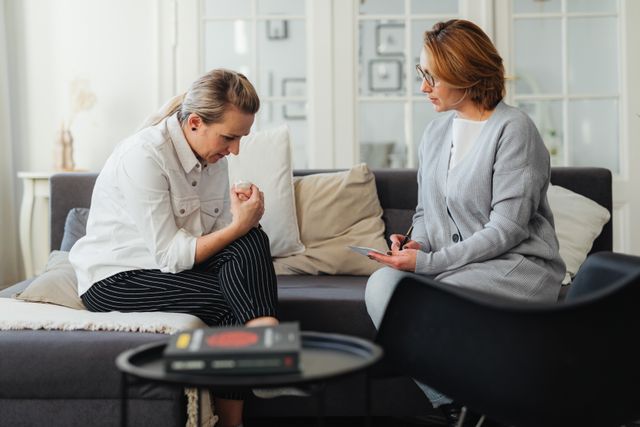
Tired. Stressed. Wired. Can’t sleep. This is how most Australians talk about their anxiety when it is already in control. Anxiety is not mentioned by name here since it is good at hiding under another name, such as an efficiency problem, a sleep problem, a personality flaw, or simply the price one has to pay for being busy.
This gap between experiencing anxiety and knowing what it is is why treatment gets delayed sometimes for many years. As per the Australian Bureau of Statistics National Study of Mental Health and Wellbeing, 17.2% of Australians aged 16 to 85, or 3.4 million people, had a 12-month anxiety disorder based on their symptoms. Anxiety is the most common mental health problem in Australia. The number of people who receive treatment is far lower than that number, and that is not due to lack of access but rather the awareness of the problem.
What anxiety does to the body before it reaches your thoughts
People rarely recognise anxiety through their thoughts first; they recognise it through their body. Fast heartbeat, tense shoulders, shallow breathing, stomach problems, fatigue that is not alleviated by sleep, clenched jaw that results in a headache on Thursday afternoons. All of these symptoms are blamed on one’s diet, job, posture, or some other factor that needs to be changed.
Anxiety disorders are not just a problem of the mind, but a nervous system disorder with predictable physical consequences. The more the threat-response system is engaged, the more the body suffers from it as a whole. Some physical symptoms that may be associated with anxiety are:
- Muscle tension or jaw clenching without an apparent cause
- Sleep problems, which cannot be alleviated by going to bed early
- Gastrointestinal disturbances, which occur under stress and stop when the stress subsides
- Palpitations or chest tightness when there is no cardiac issue present
- Fatigue that cannot be relieved by rest
It is significant in terms of gaining access to treatment because people who do not correlate these symptoms with a mental disorder will not be looking for treatment. They will be looking for a remedy for their headaches. In Australia, the usual way of getting a diagnosis starts with a general practitioner, who will be able to discount any physical problems and, if there is anxiety, give a Mental Health Treatment Plan.
The working week is where it builds
For most Australians, anxiety is not an abstraction. It is the email inbox that replenishes overnight, the performance review that moved the goal posts, and the obliteration of the line between work and private life. The disorder brews silently in a schedule that never quite allows time for its manifestation.
According to the Australian Burden of Disease Study conducted by the Australian Institute of Health and Welfare, mental and substance use disorders make up 15% of the burden of disease in Australia. Anxiety is right there among them. The sheer number of individuals suffering from a symptom that affects their ability to function.
Anxiety therapy online is an option that works around a working week in a way that face-to-face treatment simply cannot. A therapy session scheduled in the morning before the day starts, during lunch hour, or after everyone else in the house goes to bed at night is not a luxury. It is a necessity for a certain number of Australians.
What actually happens in an online anxiety session
Beyond the decision to seek help, the second area of uncertainty tends to be the nature of the help itself. Anxiety therapy in Australia consists of clinical interventions conducted by registered psychologists over secure video connections, or iCBT programs created in hospitals and universities. The intervention methods used are exactly the same as those used in face-to-face treatment:
- CBT (Cognitive Behavioural Therapy): a method of challenging the thought processes responsible for an anxious reaction; it is the first-line intervention in Australian guidelines and easily translated to the online setting
- ACT (Acceptance and Commitment Therapy): a method of observing anxious thoughts without reacting to them; very popular among structured online programs
- Exposure-based interventions: useful for treating specific phobias, social anxiety, and panic disorder; can be conducted remotely while the actual exposures take place in a patient’s real-life environment
- Psychoeducation modules: structured education on the cycle of anxiety, conducted via the validated iCBT platforms as stand-alone programs with optional therapist consultations
It should be pointed out that for a disorder characterised by avoidance behaviour, minimising the hassle associated with the process of receiving treatment is a clinically important factor. The format eliminates the anticipatory anxiety many people have about visiting a clinic.

Where online care has honest limits
Credibility here demands pointing out what online anxiety therapy doesn’t fit.
- Severe cases, especially when it comes to complex trauma, multiple comorbid conditions or suicidal tendencies, generally require a higher level of clinical intervention than can be offered via a telehealth visit or iCBT program.
- Internet-based interventions assume a certain level of technical skills and access; neither of these is guaranteed and particularly not in regional or remote Australia.
- Self-directed programs demand consistency. Success is dependent on commitment; opening a module is one thing and completing a program – quite another.
- Therapeutic alliance is important in anxiety therapy. For some clients, building trust in an online setting is more difficult; it’s a legitimate concern rather than a sign of personal weakness.
None of these points means avoiding online therapy. It means understanding which form of treatment is right for your particular case. An organisation that is clear about its limitations is more clinically helpful than one that promises too much. Understanding the distinction is, in a small but very concrete sense, the first informed choice in a process that values informed choices all the way through.










Leave a comment